Medical Office Cleaning Needs Different Protocols
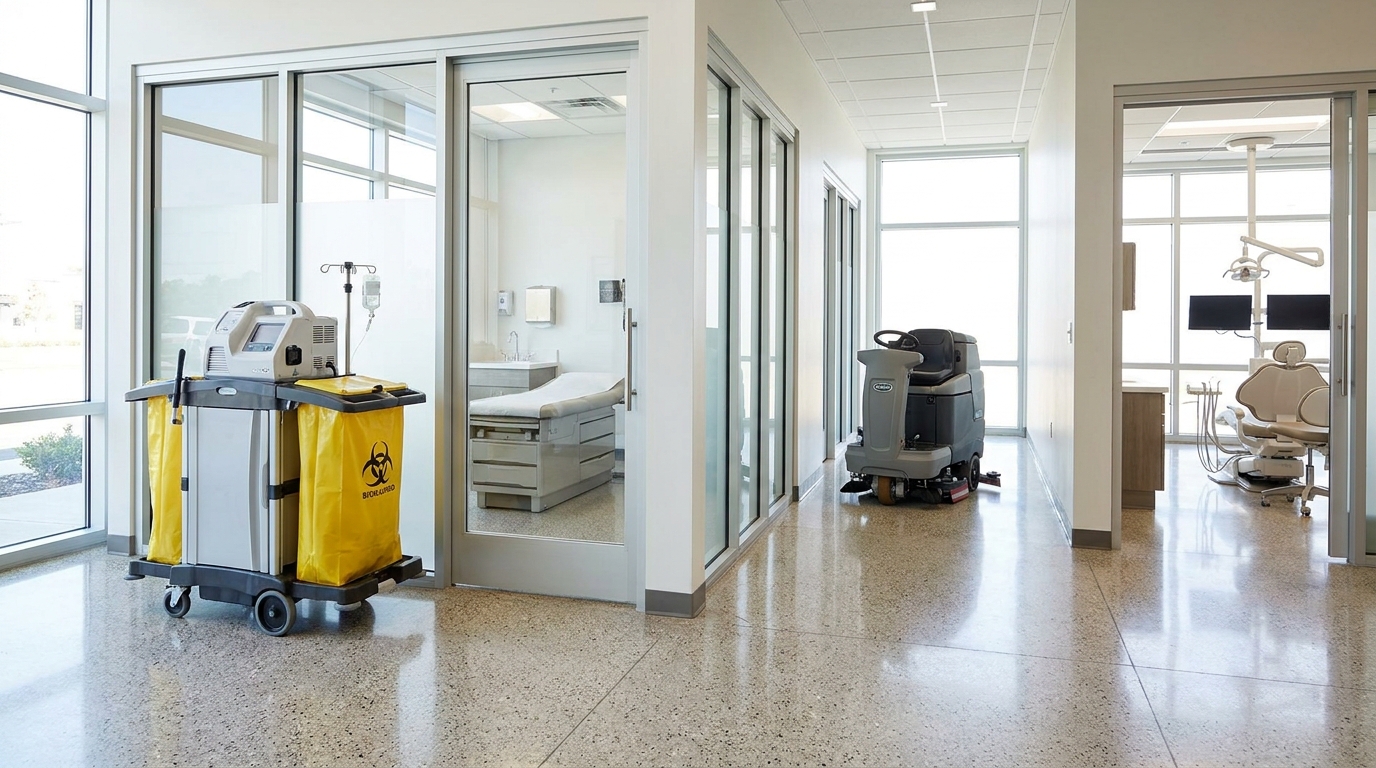
Medical office cleaning is not a nicer version of the same night work a law firm or accounting suite gets. Exam rooms, dental operatories, and clinics sit inside CDC Standard Precautions, which apply in physician offices and outpatient settings as well as hospitals, and they require EPA-registered disinfectants used at the labeled contact time on high-touch patient-care surfaces.[1] A missed light handle in an operatory is not the same as a missed conference-table edge. The chemistry, the dwell time, the color-coded tools, and the written logs exist because blood, saliva, and other potentially infectious materials actually land on those surfaces, and OSHA expects a decontamination method matched to that risk.[2]
A law-firm checklist is not a clinic protocol
CDC is blunt about the split. Detergent and water are adequate for surfaces in nonpatient-care areas such as administrative offices.[3] Patient-care areas are a different job. CDC tells facilities to use a one-step EPA-registered hospital disinfectant where the soil might include blood or body fluid, or where multidrug-resistant organisms may be present, and to wet-dust horizontal surfaces with that chemistry on a regular schedule.[3] High-touch housekeeping surfaces in patient-care areas (doorknobs, light switches, bedrails, the wall around a toilet) should be cleaned and disinfected more often than floors and other low-contact surfaces.[4]
That is why the same "empty trash, vacuum, wipe counters, restroom, done" route that works in a Matthews office park fails inside a primary-care suite in Charlotte or a dental practice in the Upstate. The waiting-room coffee table can share some of that office logic. The exam-table rails, faucet handles, light switches, drawer pulls, and chair arms cannot. CDC's core infection-prevention practices say those frequently touched surfaces in the patient-care environment get a more frequent schedule than other surfaces, and that spills of blood or other potentially infectious materials get cleaned and decontaminated promptly.[1]
Practice managers sometimes hire the vendor already on the building because the common corridors look fine. Corridor shine is not an infection-control outcome. The vendor who treats your clinic like the law firm two suites over will use the same cloth from the restroom on the treatment-room counter, wipe a disinfectant on and immediately dry it, and leave you with a checklist that says "exam rooms" without naming the high-touch list or the product contact time. That is not a protocol. It is a floor plan with a mop.
Infection-control chemistry is not whatever is in the mop bucket
Hospital-grade is a defined claim, not a marketing adjective. CDC's environmental-infection-control guidance states that germicides labeled as "hospital disinfectant" have passed EPA potency tests against three representative organisms: Pseudomonas aeruginosa, Staphylococcus aureus, and Salmonella cholerae suis.[4] Low-level hospital disinfectants may lack a tuberculocidal claim. Intermediate-level products that do carry that claim are treated as broad-spectrum enough for bloodborne pathogens on environmental surfaces, even though tuberculosis itself is not spread from those surfaces.[4][5]
CDC tells healthcare settings, including clinics and physician offices, to select EPA-registered disinfectants with activity against the pathogens most likely to contaminate the patient-care environment, then follow the manufacturer's instructions for dilution, contact time, material compatibility, storage, shelf life, and disposal.[1] EPA, which registers those products, is equally plain: the surface must stay visibly wet for the entire labeled contact time, and if it dries early the product has to be reapplied.[6] Using listed EPA-registered products consistent with the label also satisfies OSHA's bloodborne-pathogens disinfectant expectation.[6]
That last point matters in dental and medical offices because OSHA treats saliva in dental procedures as other potentially infectious material, along with blood and a list of other body fluids.[2] A restroom cleaner from a big-box store, a "sanitize" wipe with no EPA registration, or a bottle that claims "kills 99.9%" without a hospital-disinfectant label is not a substitute. EPA also publishes pathogen-specific lists (tuberculocides on List B, C. difficile spores on List K, SARS-CoV-2 on List N, bloodborne pathogens on List S) so a practice can match chemistry to the organisms it actually cares about, not to a generic citrus scent.[6]
We use EPA-registered hospital-grade products on medical accounts, including List N options where that claim is relevant, and we match chemistry to the practice's preferences and to any manufacturer limits on exam tables, dental chairs, and similar equipment. We do not fog a clinic with an unregistered product and call it infection control. CDC still does not recommend routine disinfectant fogging in patient-care areas for that older class of spray-and-hope applications.[3]
Dwell time is the part most office cleaners skip
Most EPA-registered hospital disinfectants carry a label contact time of 10 minutes. CDC notes that laboratory studies have shown activity at one minute against many vegetative pathogens, then immediately reminds users that federal law still requires the label to be followed. If a crew picks a shorter wet time than the EPA-registered label, the user takes on liability and can face enforcement under FIFRA.[3]
That is the operational gap between a standard office and a clinic. In an office, a worker sprays a counter, wipes it dry, and moves on. In an exam room, that wipe-and-go habit can leave the product off the surface before it has done the job the label promised. EPA's directions-for-use language is not optional fine print. Contact time is how long the product must remain on the surface to be effective, and the surface should stay visibly wet for that whole interval.[6]
Cleaning still comes first. CDC dental guidance is explicit: cleaning removes debris and organic contamination, and it is the necessary first step of any disinfection process. If the surface is not cleaned first, disinfection can be compromised.[5] OSHA's housekeeping eTool makes the same sequence for blood: visible blood has to be cleaned thoroughly before the disinfectant goes on, then the surface is left wet for the times on that product's HIV/HBV instructions (on labels OSHA has reviewed, 30 seconds for HIV-1 and 10 minutes for HBV, always per the actual EPA-approved label).[7]
A night crew that is paid to "hit 20 exam rooms" will not leave a tuberculocidal wet on a counter for 10 minutes unless the scope, the training, and the clock say so. That is a staffing and protocol problem, not a mop problem. Our medical scopes write dwell time into the work, because a dry, shiny exam room that never stayed wet is not disinfected.
High-touch surfaces and the dental operatory problem
CDC splits dental environmental surfaces into two groups that a generic office checklist never names. Clinical contact surfaces (light handles, bracket trays, dental-unit switches, computer equipment) are likely to pick up spray, spatter, or contaminated gloves. Housekeeping surfaces (floors, walls, sinks) do not contact patients or devices the same way and carry a lower transmission risk.[5]
For clinical contact surfaces that are not barrier-protected, CDC's current dental recommendations are to clean and disinfect with an EPA-registered hospital disinfectant after each patient, and to step up to an intermediate-level (tuberculocidal) product if the surface is visibly contaminated with blood.[8] Barriers on hard-to-clean items (chair switches, computer equipment) get changed between patients; if the surface under the barrier is soiled, it still needs cleaning and disinfection.[5] Housekeeping surfaces can be cleaned with soap and water, or cleaned and disinfected if they are visibly contaminated with blood.[5]
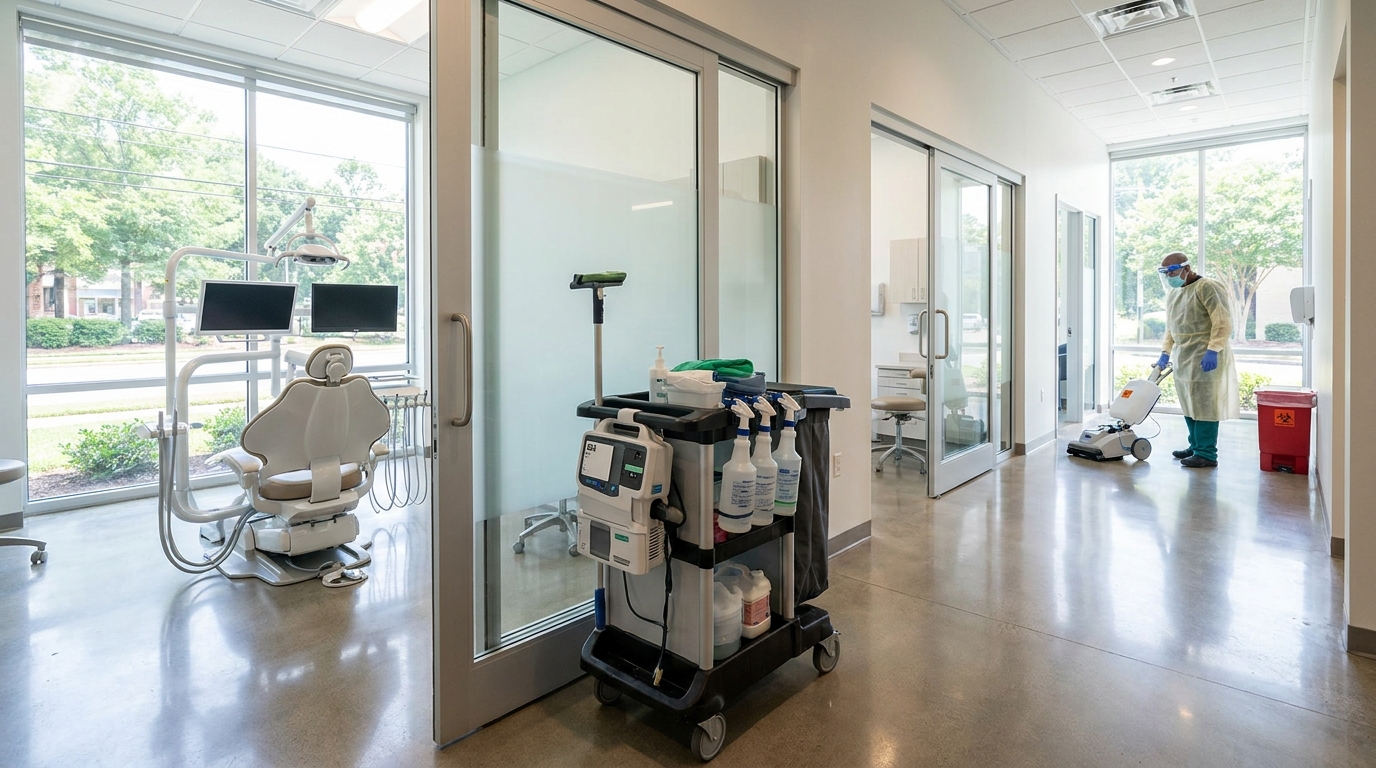
That between-patient turnover is clinical staff's job during the day. End-of-day environmental work is where a medical cleaning vendor either helps or gets in the way. If our crew treats an operatory like a break room, the night pass will miss the high-touch list, drag a restroom mop through the chair bases, and leave splash-prone counters looking "done" because they look empty. CDC's environmental-services chapter is clear that transfer from surfaces to patients is largely via hands, which is why high-touch items in the patient-care environment get more frequent cleaning and disinfection than low-touch floors and ceilings.[4]
The same logic applies in medical exam rooms and urgent-care bays, even without a dental unit. CDC estimated about 518,000 healthcare-associated infections in US acute-care hospitals in a 2023 hospital prevalence survey, with about 1 in 38 hospital patients having at least one such infection on a given day.[9] That is hospital data, not a clinic rate, and it should not be pasted onto a suburban practice. It does show why infection-control programs treat the environment as more than cosmetics: 61% of those 2023 hospital HAIs were not tied to a device or procedure.[10] Outpatient clinics are not hospitals, but CDC wrote Standard Precautions, including environmental cleaning and disinfection, for every setting where care is delivered, including clinics, urgent care, and physician offices.[1]
Color-coded microfiber is how you stop restroom soil from reaching an exam table
Cross-contamination is not an abstract training slide. CDC notes that mop heads and reusable cleaning cloths used for low-level disinfection can spread heavy contamination through a facility if they are not cleaned, if solutions are not changed, and if dirty cloths sit in dirty solution.[4] Bucket solutions become contaminated almost immediately, and continued use transfers more organisms to each next surface.[4] Cloths and mop heads should be laundered and dried after use. CDC also recommends replacing soiled cloths and mop heads whenever the bucket solution is dumped and remade.[4]
Color-coding is the simple control that keeps that failure mode from becoming a habit. CDC environmental-cleaning guidance calls for a supply of different colored cloths so one color is not used from toilets to patient areas, or from isolation spaces to general patient areas. The example mapping is red for toilet areas, blue for general patient areas, and yellow for isolation.[11] Microfiber is often preferred over cotton because it picks up more soil and microorganisms, with the caveat that high-pH chemistry (especially chlorine) can damage it, so product compatibility has to be checked.[11]
A law-firm cart does not need that discipline. A medical cart does. If the same yellow cloth that just finished a restroom stall then wipes the exam-table base, the vendor has just connected two risk zones that CDC tells you to keep apart. Our medical crews use color-coded microfiber for restrooms, treatment areas, and common spaces, and those cloths are laundered separately. The color is the control. Memory is not.
We also keep clean and soiled tools separated on the cart, and we do not "top off" leftover disinfectant in a dirty bottle. CDC warns that dilute disinfectant solutions can themselves become reservoirs when they are mixed in dirty containers, stored too long, or prepared incorrectly.[4] That is not how an office janitor thinks. It is how a clinic crew has to think.
OSHA expects a written decontamination schedule, not a memory
OSHA's Bloodborne Pathogens Standard is not a hospital-only rule. It applies wherever there is occupational exposure to blood or other potentially infectious materials.[2] Housekeeping staff who clean exam rooms, operatories, and clinical restrooms reasonably anticipate that exposure. The standard requires the employer to keep the worksite clean and sanitary, and to implement a written schedule for cleaning and a method of decontamination based on four things: location in the facility, type of surface, type of soil, and the tasks or procedures done in that area.[2]
That sentence is the gap a generic office checklist cannot close. "Wipe all counters nightly" does not vary by location, surface, soil, or procedure. OSHA also requires environmental and working surfaces to be cleaned and decontaminated after contact with blood or OPIM: after procedures, immediately when a surface is overtly contaminated or after a spill, and at the end of the shift if the surface may have become contaminated since the last cleaning.[2] Protective coverings get replaced when they are overtly contaminated or at the end of the shift. Reusable bins and pails with a reasonable chance of contamination get inspected and decontaminated on a schedule, and immediately when they are visibly dirty.[2] Broken glass that may be contaminated is not picked up by hand.[2]
OSHA's housekeeping guidance restates the same written-schedule test and defines "appropriate disinfectant" as diluted bleach or EPA-registered products such as tuberculocides, sterilants, HIV/HBV-effective registrations, and FDA-cleared high-level disinfectants, used according to the label.[7] A vendor that cannot show you which product, which dilution, which contact time, and which rooms that schedule covers is not meeting the spirit of that rule, even if the carpets look good at 7 a.m.
CDC dental programs put the same expectation in infection-prevention language: policies and procedures for routine cleaning and disinfection of environmental surfaces belong in the infection-prevention plan, EPA-registered hospital disinfectants or detergent-disinfectants labeled for healthcare should be selected, and manufacturer instructions for amount, dilution, contact time, safe use, and disposal should be followed.[8] CDC core practices also require written, current, evidence-based infection-prevention policies, plus monitoring of adherence with feedback to staff and leadership.[1]
Logs that a practice manager can actually use
A written schedule on a binder shelf does not prove last night's work happened. CDC's core practices ask facilities to identify and monitor adherence to infection-prevention requirements, to train the people who monitor, and to use standardized tools.[1] Dental programs are told to keep sterilization monitoring records so a failure can be traced. Environmental cleaning needs the same paper trail even though the work is surfaces, not autoclaves.
That is why we log medical visits. The log is not theater. It is how a practice manager in the Triangle or the Triad shows an auditor, an insurer, or a landlord that the OSHA schedule was followed, which product was used, which rooms were completed, and what exceptions showed up (a spill, sharps left out of a container, damaged equipment). If something unusual is found, a written exception report goes to the facility manager. A law-firm janitorial ticket that says "cleaned suite 200" cannot do that job.
Documentation also protects the practice when clinical staff and environmental staff share a space. Between-patient clinical contact disinfection stays with the chairside team. Our end-of-day or scheduled environmental pass should not collide with that work, and it should not pretend to reprocess instruments. Critical and semicritical devices are a clinical reprocessing lane. Our lane is the room around them: floors, restrooms, high-touch housekeeping surfaces, and the environmental surfaces that CDC and OSHA actually assign to environmental services.
What to ask a vendor before you hand over the keys
If you manage a practice in North Carolina or South Carolina, ask questions a standard office cleaner cannot answer.
- Which EPA-registered hospital disinfectant will you use in exam rooms and operatories, and what is the labeled contact time for the organisms we care about?
- How do you keep restroom cloths and mops out of treatment rooms (color-coding, separate laundering, cart setup)?
- What is the high-touch list for our layout, not a generic "wipe counters" line?
- How do you handle blood or OPIM spills, including PPE, soil removal before disinfectant, and wet time?
- What does the visit log include, and how fast do exception reports reach the practice manager?
- Who is assigned to this account, and have they been trained on bloodborne pathogens and dwell time?
We quote medical cleaning after an on-site walk-through with the practice manager or compliance lead. That walk is how the written OSHA-style schedule gets built around your rooms, your surfaces, and your procedures, not around a template copied from an office account. Standard commercial quotes can often proceed without a site visit. Medical work does not, because the margin for error is smaller and the chemistry has to fit the equipment in the room.
We have done this work in the Carolinas since 2002. We take the jobs other cleaners will not, including the unglamorous parts of clinic hygiene that never show up on a "sparkling lobby" flyer. Same assigned crews. Documented visits. Bilingual teams. Fully insured and bonded. If the building needs a 24/7 emergency response after a spill, that is in our wheelhouse too.
Medical office cleaning is a protocol. Treat it like one, or you will pay for office cleaning and still own clinic risk.
Practical takeaways
- CDC Standard Precautions, including environmental cleaning and disinfection with EPA-registered products at labeled contact times, apply in clinics and physician offices, not only in hospitals.[1]
- Detergent and water can be enough in administrative offices. Patient-care rooms need hospital-disinfectant chemistry, a high-touch list, and a wet contact time the label actually states.[3][6]
- In dental operatories, clinical contact surfaces that are not barrier-protected are cleaned and disinfected with an EPA-registered hospital disinfectant after each patient, with a tuberculocidal product if blood is visible.[5][8]
- Color-coded, separately laundered microfiber keeps restroom soil off exam-room surfaces. Reusing one dirty cloth or mop solution across rooms can spread contamination instead of removing it.[4][11]
- OSHA 29 CFR 1910.1030 requires a written cleaning and decontamination schedule based on location, surface, soil, and procedures, plus prompt decontamination after blood or OPIM.[2]
- Visit logs and exception reports are how a practice proves the schedule was followed. A generic "suite cleaned" ticket is not a medical record of the work.
How we can help
If your exam rooms, dental operatories, or outpatient clinic in the Carolinas are still being cleaned on a law-firm checklist, we will walk the space with you, write a healthcare-specific scope, and put assigned crews on a documented protocol. Review our medical and healthcare facility cleaning service, or contact us for a walk-through and written quote. You can also see how we handle disinfection and sanitization when you need hospital-grade chemistry applied with a logged dwell time, not a spray-and-wipe.
Citations
- CDC, "CDC's Core Infection Prevention and Control Practices for Safe Healthcare Delivery in All Settings" (2024-04-12)
- Occupational Safety and Health Administration, "29 CFR 1910.1030 Bloodborne pathogens" (current)
- CDC / HICPAC, "Recommendations for Disinfection and Sterilization in Healthcare Facilities" (2023-12-07)
- CDC, "E. Environmental Services (Guidelines for Environmental Infection Control in Health-Care Facilities)" (2024-01-08)
- CDC, "Best Practices for Environmental Infection Prevention and Control" (2024-05-15)
- U.S. EPA, "Selected EPA-Registered Disinfectants" (2026-08-24)
- Occupational Safety and Health Administration, "Hospitals eTool: Housekeeping, Biological Hazards, Infectious Diseases" (current)
- CDC, "Sterilization and Disinfection (Summary of Infection Prevention Practices in Dental Settings)" (2024-05-15)
- CDC, "HAIs: Reports and Data" (2026-07-15)
- CDC Newsroom, "New CDC Data Shows Decline in Healthcare-Associated Infections" (2026-07-15)
- CDC, "Cleaning Supplies and Equipment (Best Practices for Environmental Cleaning in Global Healthcare Facilities with Limited Resources)" (2024-03-19)